
Many people think a tan is a sign of health. In reality, a tan is your skin’s response to damage caused by ultraviolet (UV) radiation.
Want proof? Take a look at your forearms.
Compare the front of your lower arm (the side that usually faces your body) to the back of your lower arm (the side that faces the sun when you’re walking/driving). Many people notice more brown spots, more uneven color, and more fine lines on the back of the arm.
That difference is not a mystery, and it’s not simply “getting older.” It’s a visible record of years of sun exposure and accumulated UV damage.
What Is Ultraviolet (UV) Radiation?
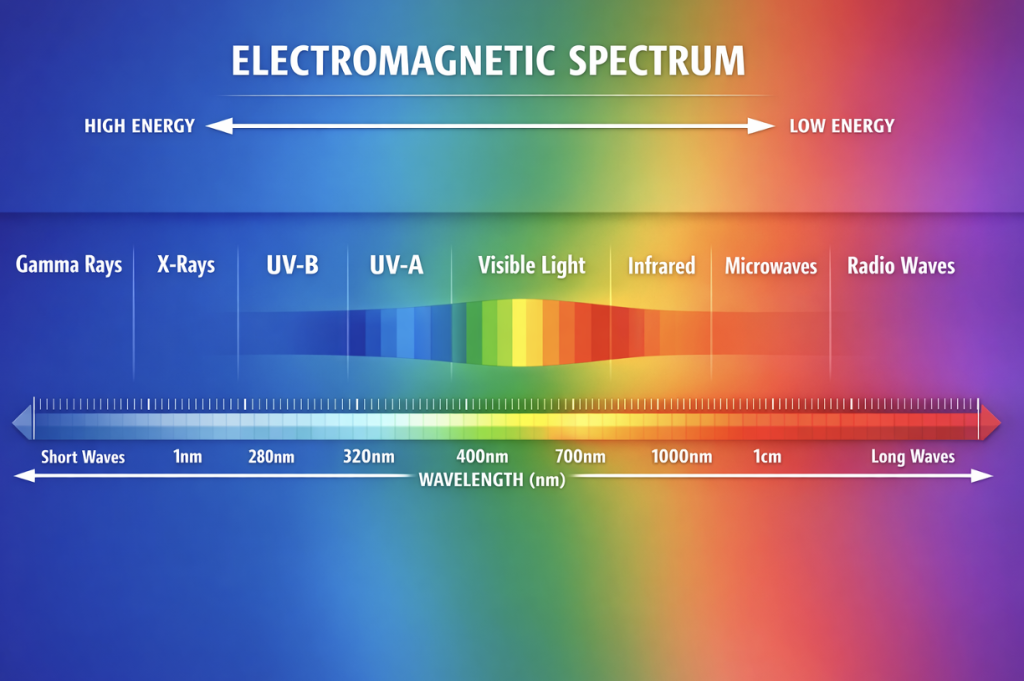
UV radiation is part of the electromagnetic spectrum, a range of invisible and visible energy waves that travel through space. This matters because we often think about sun protection when it is bright or warm outside, UV light is not visible and cannot be felt as heat. You can be cool and comfortable and still get a strong UV dose. Even on cold, cloudy days your skin is still accumulating UV damage.
Understanding UVA And UVB Rays
UV light is further divided into UVA and UVB segments. They differ in how deep they penetrate into the skin and how they interact with tissue.
UVA Rays: The Aging Rays
UVA rays make up most of the UV radiation that reaches the ground. These rays penetrate deeper into skin and are largely responsible for long term skin damage.
Unlike UBA rays, UVA rays cause little to no noticeable sunburn compared. Instead, the damage happens gradually over time. Over years, that translates into wrinkles, sagging, rough texture, and blotchy brown spots – what many people mistakenly label as “just aging.” The brown spots and the texture difference between the back and front of the lower arm are a perfect example of UVA’s effect.
Fun fact: a 2015 study published in JAMA Dermatology found that airline pilots flying for just 56 minutes at 30,000 feet receive about the same amount of UVA radiation as a 20-minute tanning bed session.
UVB Rays: The Burning Rays
UVB rays don’t penetrate as deeply into the skin, but they are the primary cause of sunburn and direct genetic material damage near the skin surface. Even when the body repairs much of the damage, repeated exposure increases the chance that mistakes happen during the repair process. Over time, those mistakes can contribute to skin cancer.
Unlike UVA rays, standard glass blocks most UVB radiation. That’s why you’re typically not sunburned while driving or sitting inside behind the window. However, UVB exposure can be intensified by reflective surfaces such as water, sand, or snow, which is why you may feel more burnt after a beach or pool day, even if you were underwater.
What Causes a Tan?
Many people think a tan is a sign that their skin is healthy or adapting to the sun. In reality, a tan is your body’s response to UV damage.
When UV radiation reaches your skin, it triggers the production of melanin, the pigment that causes your skin to darken. This is your body’s attempt to protect itself from further damage, not a sign that the damage didn’t occur.
Think of a tan as your skin putting up a shield after it’s already been injured.
While a tan may not be as obvious as a sunburn, both are signs that UV radiation has damaged skin cells. Over time, that damage accumulates and can contribute to premature aging, sun spots, wrinkles, and an increased risk of skin cancer.
Many people are surprised to learn that this damage can happen even when they’re not actively trying to tan. Learn why daily sunscreen use matters year-round.
What About Vitamin D?
Vitamin D is naturally produced in our skin upon UVB exposure. But how much exposure do we need?
It depends on many factors including your age, the latitude you live in, or the time of day. In general, 5–30 minutes of midday sun exposure to the face, arms, or legs 2–3 times per week is sufficient.
Only a small fraction of the UVB exposure needed to cause a sunburn is sufficient for vitamin D production.
If you’re spending time outdoors, choosing the right sunscreen can help protect your skin while still enjoying outdoor activities. Read our comparison of mineral and chemical sunscreen.
Is a Tan Healthy?
Simply put: there is no such thing as a healthy tan. Tanned skin is damaged skin.
Whether it’s a sunburn or a tan, both are signs that your skin has been exposed to damaging UV radiation. Protecting your skin with sunscreen, protective clothing, shade, and smart sun habits can help reduce your risk of premature aging and skin cancer.
A tan may be common, but that doesn’t make it healthy.